
Lowest Price Guaranteed
Slides
236
Last Updated
May 2026
View Count
18010
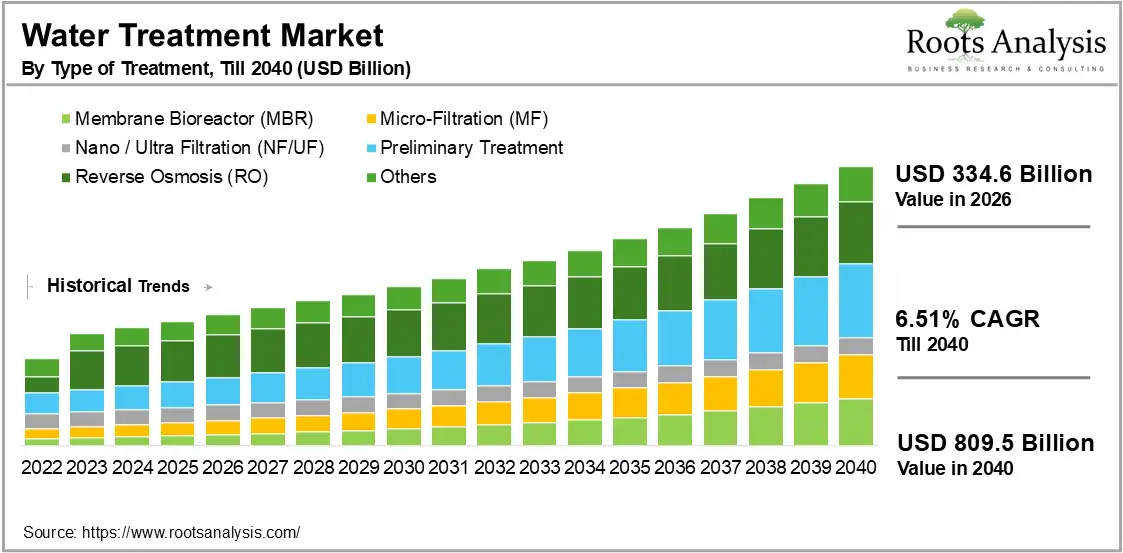
The water treatment market size is projected to grow from USD 334.6 billion in 2026 to USD 809.5 billion by 2040, representing a CAGR of 6.51%, during the forecast period till 2040.
 |
To learn more about this report, request a free sample copy
The new research study consists of industry analysis, detailed global water treatment market analysis, mega trends, patent analysis, porter five forces, SWOT analysis, value chain analysis and other strategic frameworks.
According to the UN World Water Development report, nearly half of world’s population experience water scarcity at least once a year. This signifies the emergence of water treatment and has proven to be one of the efficient ways to clean and safe water supply across various industries. Functioning of water treatment typically involves removing contaminants and impurities from water, ensuring its suitability for drinking, industrial processes, and environmental sustainability. The growing need for efficient purification solutions is driving the use of high-performance adsorbents in industrial and municipal water treatment applications.
To prevent fouling in filtration and desalination systems, antiscalants are widely used to enhance membrane longevity and process efficiency. Few of the major advantages of water treatment include improved water quality, enhanced equipment lifespan, increased operational efficiency, and compliance with health regulations. It is worth noting that utilization of water treatment in major industries is surging due to rapid penetration of wastewater management technology and rising awareness among masses. Interestingly, more than 2 billion people do not have safe drinking water services.
The water treatment market is emerging as a critical component in the global shift towards modern water treatment innovation and digital advancement to reach higher safe water availability. Innovations, including advanced membrane technologies, which enhance contaminant removal while reducing energy consumption. Additionally, carbon-based purification methods utilize materials such as activated carbon and graphene to effectively absorb a wide range of pollutants, including micropollutants and organic compounds. Consequently, with continuous water treatment technological advancements such as integration of modular water treatment systems and desalination market analysis, as the demand for safe water continues to grow, the water treatment market is anticipated to witness noteworthy growth during this forecast period. Notably, Henrik Henriksson, CEO of Stegra mentioned that the water treatment processes are a crucial component of our facility, which serves as a global integrated plant for hydrogen production, iron, and steelmaking.
The water treatment market research report presents an in-depth analysis of the various service providers that are involved in offering water treatment market, across different segments, as defined in the table below:
| Key Report Attributes | Details | |
| Historical Trend | Since 2022 | |
| Forecast Period | Till 2040 | |
| Market Size Value in 2026 | $ 334.6 Billion | |
| Market Size Value by 2040 | $ 809.5 Billion | |
| CAGR (Till 2040) | 6.51% | |
| Type of Treatment |
|
|
| Type of Application |
|
|
| End-User |
|
|
| Type of Investment |
|
|
| Type of Enterprise |
|
|
| Geographical Regions |
|
|
| Leading Market Players | ||
| PowerPoint Presentation (Complimentary) |
Available | |
| Customization Scope | 15% Free Customization | |
| Excel Data Packs (Complimentary) |
|
|
Based on the type of treatment, the global water treatment market is split into membrane bioreactor (MBR), micro-filtration (MF), nano/ultra filtration (NF/UF), preliminary treatment, reverse osmosis (RO), sludge management techniques and others. Currently, among the categories, the preliminary treatment segment holds nearly 35% of the market share in 2026. This can be attributed to its critical role in enhancing the efficiency and effectiveness of subsequent treatment processes. However, the reverse osmosis technology segment is expected to grow at a relatively higher (8.37%) growth rate over the forecasted period. Prominent reasons for this dominance include its exceptional efficiency in removing contaminants and its adaptability to various water sources, including seawater and wastewater.
The global water treatment market is fragmented into multiple types of application, namely wastewater treatment, zero liquid discharge and others. Currently, the wastewater treatment segment is anticipated to dominate the segment with more than 40% of the water treatment market share in 2026. The prominent reason for this dominance is the urgent need for municipalities to provide safe drinking water and manage increasing volumes of biological wastewater treatment processes due to rapid urbanization and population growth. However, the zero liquid discharge segment is expected to grow with a relatively higher (9.16%) CAGR in the forecasted period. This can be ascribed to increasing environmental regulations in water treatment and heightened public awareness of wastewater's negative impacts, prompting industries to adopt sustainable water treatment practices.
The global water treatment market is fragmented into multiple type of end-user, namely commercial, industrial and residential. Currently, the commercial segment is anticipated to dominate the segment with more than 60% of the market share in 2026. Additionally, this segment is expected to grow with a relatively higher CAGR in the forecasted period. This can be ascribed to rising urbanization, expansion of commercial infrastructure and increasing corporate social responsibility drives.
Based on the types of investment, the global water treatment market is segmented into government-funded projects, private sector investments and public-private partnerships. According to our analysis, the private sector investments segment is likely to hold over 45% of the market share and is expected to grow at a higher CAGR during the forecasted period till 2040. The key propelling factor includes advancements in water treatment technology that have significantly lowered costs, rising government support and private sector investments are often more agile and responsive to market demands compared to government-funded projects.
Based on the types of enterprise, the global water treatment market is segmented into large enterprises and small and medium enterprises. According to our analysis, the large enterprise is leading the segment with more than 65% of market shares and are expected to growth with a relatively higher CAGR in the forecasted period. This can be attributed to its capacity to invest in advanced water treatment equipment and techniques, benefit from government initiatives, increase economies of scale, and drive business growth.
This segment highlights the distribution of water treatment across various geographical regions, such as North America, Europe, Asia, Latin America, Middle East and North Africa, and the rest of the world. According to our analysis, North America exhibits dominance in the market with more than 40% of water treatment market share in the global marketplace in 2026. This can be ascribed to the region’s stringent environmental regulations, investment in technological advancements and increasing urbanization and population growth, driving demand for clean water. However, Asia is expected to grow with a relatively higher CAGR in the forecasted period. This can be attributed to rapid urbanization and industrialization, government initiatives and water treatment investments, rapid population growth and increasing energy demand in countries like China and India. For instance, recently in April 2024, Thermax launched a new manufacturing facility in Pune, India for water and wastewater treatment solutions research, aiming to enhance its production capabilities.
The demand for clean water is increasing, which will make water treatment a crucial innovation in the water management sector. Key driving factors include rising water scarcity, water treatment technological advancements, increasing awareness about sustainability and industrialization leading to higher water consumption and wastewater generation. Further, the rise in government support and initiatives promoting water treatment innovation will play a crucial role in shaping the future of water treatment market innovation. Notably, growing health concerns over waterborne diseases and increased environmental awareness further propel investments in eco-friendly treatment. Recently, in August, Governor Kathy Hochul announced the approval of $265 million in financial assistance for water infrastructure projects across New York State.
With the presence of several small and large water treatment companies, the market is experiencing intense competition and changing market dynamics. From large multinational companies to local water treatment players, companies are striving to enhance their competitive edge. In terms of market share, large enterprises and multinational companies are dominating the market. While small water treatment players are continuously improving their products to cater to niche markets, or they are offering specialized services. These industry players are focusing on adopting competitive strategies, such as developing innovative water treatment techniques, forming strategic alliances and partnerships to expand their portfolios and global footprint, investing in recent developments and new feature launches to enhance their water treatment offerings.
Despite strong market growth projection, the water treatment market faces numerous challenges, including high upfront capital required for setting up advanced water treatment facilities, higher operational cost and issues related to water scarcity and pollution that necessitate effective solutions. Notably, some of the other challenges are pressure to adopt new technologies that enhance treatment efficiency while reducing costs and external factors like the COVID-19 pandemic and natural disasters that disrupt supply chains and operations. Additionally, fluctuating policies and regulations can create an unpredictable environment for investors in the water treatment sector. Further, lack of education and skilled labor can reduce water treatment adoption across regions. Addressing these mentioned challenges is essential for the expansion of the market growth in the near future.
With respect to regional analysis of water treatment market insights, North America is likely to dominate the market for water treatment. Primarily, due to its stringent regulations and increasing consumer awareness of health risks from contaminated water, the region has a few key market drivers. The region's industrial businesses are readily adopting new water treatment solutions, as technological advancements have reduced costs, making water treatment more economically viable. Notably, there has been a strong funding attraction in the region, with ongoing government support to ensure continued market expansion.
Examples of key players involved in the water treatment market (which have also been captured in this market report, arranged in alphabetical order) include 3M, Acciona, American Water, Aquatech International, ASIO, BioMicrobics, DuPont, Ecolab, Evoqua Water Technologies, Kemira, Kurita Water, Pentair, Suez, Thermax Global, Trojan Technologies, Veolia, Voltas and Xylem. This market report includes an easily searchable excel database of all the companies who have adopted the market.