Dental 3D Printing Market (2nd Edition): Distribution by 3D Printing Component (Printing Machines, Materials, Software, and Services), 3D Printing Technology (VAT Polymerization, Polyjet Technology, Powder Bed Fusion, and Metal Extrusion Technology, and Others), Application Area (Prosthodontics, Orthodontics, Dental Implants, and Others), Type of Product, Type of Material, and Geographical Regions- Trends and Forecast 2026-2035
Market Size
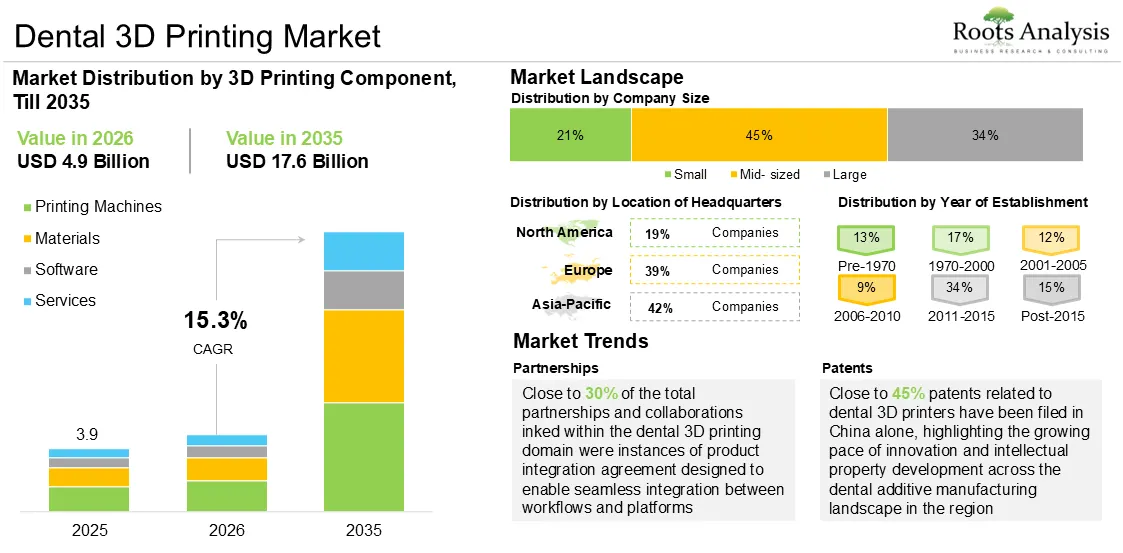
The global dental 3D printing market, valued at USD 3.9 billion in 2025, is projected to reach USD 4.9 billion in 2026 and USD 17.6 billion by 2035, with a CAGR of 15.3% during the forecast period 2026-2035.
See What’s in the Full Report – Request Your Complimentary Insights!
Market Report: Key Takeaways
- In terms of type of 3D printing component, printing machines hold the highest share of nearly 40% of the overall dental 3D printing market.
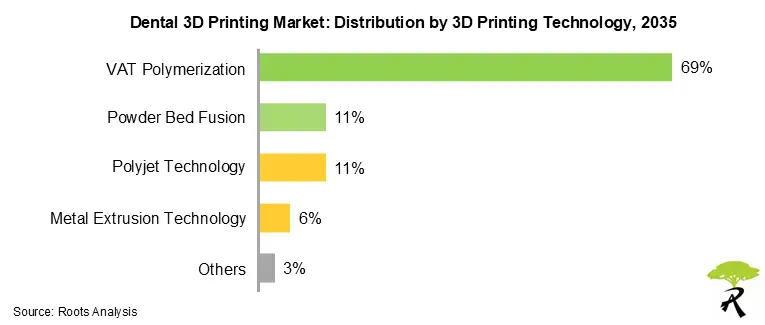
- Amongst 3D printing technologies, VAT polymerization captures largest share (70%) of the current dental 3D printing market.
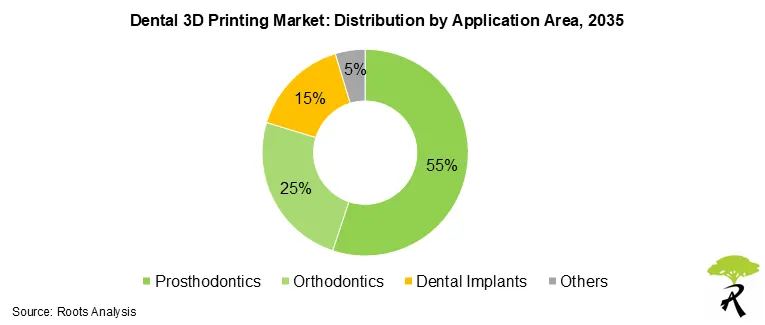
- Prosthodontics, with a 55% share, is the most popular application area in the dental 3D printing market.
- In terms of type of product, crowns and bridges capture largest (~30%) share of the current dental 3D printing market.
- With respect to types of material, resins hold the highest market share (50%) share of the current dental 3D printing market.
- North America captures the majority market share; Asia-Pacific, though, is likely to grow at a faster rate in the near future.
Key Market Statistics
- Market Size in 2026: $4.9 Billion
- Estimated Market Size in 2035: $17.6 Billion
- CAGR (2026-2035): 15.3%
- North America: Largest market in 2026
- Europe: Fastest growing region
Want Information on Specific Region / Segment?
What is 3D Printing?
3D printing, also known as additive manufacturing, is a method of producing 3-dimensional objects layer-by-layer, using a computer aided design. Owing to its ability to print complex models using a wide range of materials, 3D printing has applications across various industries, including dental, aerospace, automotive, healthcare, food, fashion, mechanical engineering and other manufacturing industries. In recent years, the adoption of 3D printers has risen at a commendable pace, specifically in the dental industry. This is primarily due to the increasing scope of in-house dental 3D printing, growth in digital dentistry business and rise in the demand for 3D printed products.
3D printing for dentistry is an advanced solution that produces high quality and more accurate dental products (including, crown and bridges, dentures, surgical guides and dental implants). The process of dental 3D printing is time saving and economical for both the patients and dentists. Driven by the growing prevalence of dental diseases and rising demand for high quality dental equipment, the dental 3D printing market is likely to witness a rapid growth in the foreseen future.
Recent Developments
- In July 2026, Pac-Dent launched Rodin Chroma Flash, a flash post-polymerisation system designed for dental 3D-printing workflows. The launch expands Pac-Dent’s Rodin digital dentistry ecosystem with dedicated post-processing technology.
- In July 2026, Rapid Shape collaborated with Atlanta Dental in order to expand advanced chairside 3D printing across the US. The collaboration combines Rapid Shape’s dental printers with Atlanta Dental’s regional distribution and technical support.
- In June 2026, Dentsply Sirona and HeyGears expanded their digital denture collaboration by validating Lucitone Digital Print Denture resins for one-piece production on HeyGears’ UltraCraft Multi-Material Fusion DLP printer.
- In June 2026, SHINING 3D Dental launched AccuFab-Aris, an entry-level professional chairside dental 3D printer in Hangzhou, China.
Dental 3D Printing Market Trends
- Partnerships and Collaborations: Several dental 3D printing companies have recently formed strategic agreements with other players to strengthen their presence in this field. Product integration agreements dominate the dental 3D printing market, followed by distribution agreements. This predominance of integration agreements is driven by the need to rapidly combine complementary technologies, ensure regulatory and clinical compatibility, expand company reach, and offer end-to-end workflows that accelerate adoption among dental labs and clinics.
- Patent Applications for Dental 3D Printing: companies have filed over 530 patents focusing on dental 3D printing, since 2019. Majority of the patents (65%) are patent applications (not having received approval yet), reflecting the rapid pace of innovation in the domain where developers strategically secure early filing dates to protect their groundbreaking advancements while the patent review process progresses. Concurrently, most of the patents (82%) have been filed by industry players.
Scope, Methodology and Industry Experts Interviews
Roots Analysis segments the dental 3D printing market 3D printing components, 3D printing technology, application area, type of product, type of material, and geographical regions.
The opinions and insights presented in this study were influenced by discussions conducted with multiple stakeholders across the dental 3D printing domain. The market report includes detailed transcripts of the following third-party discussions:
- Chief Executive Officer and Founder, Small Company, Denmark
- Chief Executive Officer, Large Company, China
- Chief Executive Officer, Mid-Sized Company, US
- Chief Executive Officer, Small Company, Croatia
- Co-founder, Chief Product Officer, Mid-sized Company, US
- Co-founder, Large Company, US
- Senior Vice President, Small Company, China
- Managing Director, Mid-Sized Company, US
- Managing Director, Small Company, US
- Healthcare Lead, Large Company, US
- Dentist and Owner, Small Company, US
- Dental surgeon, Small Company, UK
Dental 3D printing market will mark a significant revolution in demand dynamics with integration of artificial intelligence as Hoss Bassir, Co-founder, SprintRay states, “AI-driven 3D printing is truly transforming dental practice. Vendors are now delivering tailored, end-to-end dental solutions, seamlessly integrating hardware, software, AI-assisted design, and materials. This is leading to shortening workflows, improving scan quality and diagnostics. Thus, lowering the learning curve for clinicians, enabling fast chairside appliance production, and accelerating product development. All of this is leading to significantly better patient care.”
Pay Only for What You Need – The Best Way to Optimize
Market Drivers
- Rising incidence of oral diseases and challenges in conventional treatment methods: The growing incidence of dental diseases, challenges associated with conventional methods of dental product manufacturing and rising demand for cosmetic dentistry, have led to the high adoption of dental 3D printers. In August 2025, WHO published a global oral health status report and marked oral diseases as the most common non-communicable disease. In 2025, nearly 3.7 billion people worldwide were affected by oral diseases including dental caries, severe periodontal disease, edentulism (total tooth loss) and oral cancer. Dental caries alone had an estimated prevalence of 2 billion worldwide.
- Technological advancements in dental 3D printing: Dental 3D printers can produce highly accurate restorations, orthodontic models, dentures, aligners (including clear aligners), crowns, retainers, bridges, as well as surgical guides. The printers work with a wide range of materials, including resins, plastics, metals, ceramics and others. Over time, there have been improvements in the materials used for 3D printing and the speed of the printers themselves. Modern systems are now capable of printing 4-5 dental crowns in less than 15 minutes. In addition, ongoing technological advancements are further accelerating the dental 3D printing market.
Market Segmentation Analysis
Printing Machines Leading the Dental 3D Printing Market
In 2026, printing machines capture nearly 40% of the overall dental 3D printing market share, owing to their ability to excel at rapid, mass-customization of patient specific products like clear aligners, dentures, and surgical guides. These high-throughput printers further reduce material waste, accelerate workflows, and deliver clinical accuracy within 35 microns. Such printing machines are likely to grow at a higher CAGR during the forecast period, driven by rising adoption in clinics and labs, faster build speeds, and expanding material compatibility. These advancements significantly reduce turnaround times and per-case costs. Declining hardware prices, financing options, and increasing in-house demand for customized dental solutions further support this momentum.
VAT Polymerization is Driving the Dental 3D Printing Industry
VAT polymerization within 3D printing technology segment currently holds ~70% of the market share, owing to its ability to deliver unmatched surface finish and dimensional accuracy for dental restorations. It also supports a wide range of biocompatible resins, offers fast print speeds and predictable workflows, and uses a mature ecosystem of materials and software that developers are already familiar with.
Market Regional Insights
North America Dominates the Overall Market
North America dominates the dental 3D printing market, securing nearly 40% of the overall revenue share. Widespread adoption of computer aided design (CAD) / computer aided manufacturing (CAM) systems has been supported by strong reimbursement and private-pay markets in the region. Dental labs and manufacturers are also driving the adoption through high R&D spend and capital investment. Favorable regulatory pathways further accelerate the commercialization of new printers and materials, while a mature clinical ecosystem of trained dentists and technicians is speeding up the adoption of digital workflows.
Europe Drives Expansion in the Dental 3D Printing Sector
Europe is playing a pivotal role in accelerating the growth of the dental 3D printing market, owing to strong regulatory harmonization across the EU. The increasing adoption of digital dentistry in both private practices and public health systems, growing investments by specialized 3D printing dental labs and startups, a robust materials and component supply chain, and active R&D collaborations between universities, clinics, and manufacturers are driving innovation in biocompatible resins and workflow integration.
Emerging Opportunities in Dental 3D Market
Next-generation chairside printers enable rapid single-visit prosthetics and streamlined clinical dental practices
Externally integrated chairside 3D printers are transforming restorative dentistry by enabling rapid, same-visit fabrication of crowns, bridges, and temporaries without the need for sending impressions to offsite labs. Systems that combine intraoral scanning, automated model preparation software, and validated in-clinic post-processing (wash / cure) workflows, reduces the turnaround from days to under an hour, cuts lab fees, and improves patient satisfaction. These dental solutions further lower logistical complexity and costs for large-scale general practices and specialty clinics by minimizing shipping, remakes, and coordination delays. As dental chains and value-based care models expand, chairside automation presents a scalable opportunity to increase case throughput, capture additional procedure revenue, and standardize quality across multi-site networks.
Modular, materials-agnostic printing platforms for multi-material prosthetics and digital orthodontics
Open, modular 3D printing lets labs and manufacturers produce crowns, surgical guides, clear aligners, and denture bases, on one production line. By separating the printer hardware from proprietary materials (using printers that accept many validated resins and thermoplastics rather than only one vendor’s cartridges) and implementing automated material change steps along with inline quality checks, they can switch rapidly between product types. This approach reduces inventory needs, shortens lead times for new indications (for instance, swapping between high-strength ceramics and soft aligner materials), and simplifies regulatory submissions through reusable validation frameworks. As a result, dental labs handling varied cases and Original Equipment Manufacturer (OEMs) integrated hardware-software solutions support higher margins and can centralize production into contract-manufacturing hubs for digital dentistry.
Dental 3D Printing Market: Scope of the Report
| Key Report Attributes | Details | |
| Segments Covered |
|
|
| Excel Data Packs (Complimentary) |
|
|
| PowerPoint Presentation (Complimentary) |
|
|
| Customization Scope |
|
|
Market Segments
Based on the research, we have segmented the Dental 3D Printing Market into 3D printing components, 3D printing technology, application area, type of product, type of material, and geographical regions.
By 3D Printing Components
- Printing Machines, Materials, Software, and Services
By 3D Printing Technology
- VAT Polymerization, Powder Bed Fusion (PBF), Polyjet Technology, Metal Extrusion Technology, and Others
By Application Area
- Prosthodontics, Orthodontics, Dental Implants, and Others
By Type of Product
- Crowns and Bridges, Models for Clear Aligners, Models for Removals, Splints or Night Guards, Surgical Guides, Impression Trays, and Base and Teeth for Dentures
By Type of Material
- Resins, Plastics, Metals, Ceramics, and Others
By Geographical Regions
- North America, Europe, Asia-Pacific, Latin America, and Middle East and North Africa
Report Authorship
This report was authored by Simriti Gupta, member of Roots Analysis healthcare and pharmaceutical research practice. Her work focuses on dental 3D printing technologies, materials and applications, as well as competitive intelligence, company benchmarking and market forecasting.
Independence and Non-Affiliation
Roots Analysis is an independent secondary and primary market research publisher. This report is not affiliated with, endorsed by, or produced on behalf of any company named or profiled within it, including all key players and industry expert interviewees referenced above.
Roots Analysis' findings draw on a combination of secondary research and primary interviews with industry experts, of the kind referenced above, to validate market sizing, segment shares, and forecast assumptions independently of any single company's disclosures.


