
Lowest Price Guaranteed
Slides
208
Last Updated
May 2025
View Count
12643
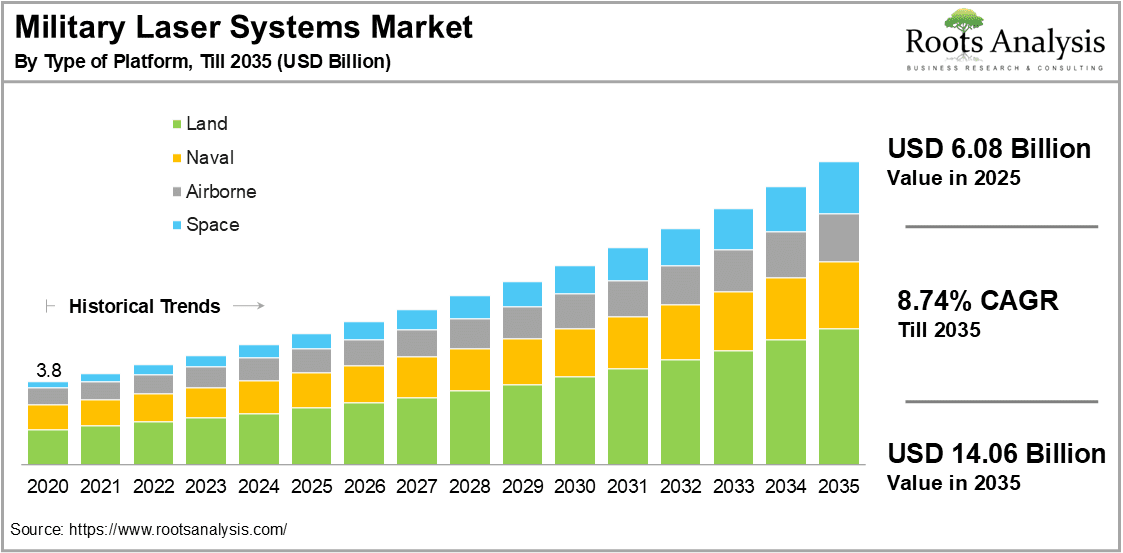
The military laser systems market size is projected to grow from USD 6.08 billion in 2025 to USD 14.06 billion by 2035, representing a CAGR of 8.74% during the forecast period till 2035.
 |
The new research study consists of military laser systems market and trends analysis, detailed market forecast analysis, and provide actionable strategic recommendations.
The military laser system market is poised for unprecedented growth, driven by a confluence of factors that underscore the critical role of lasers in modern warfare. As nations seek advanced solutions to counter emerging threats, military laser systems have become increasingly vital. Military laser systems refer to a directed energy weapon (DEW) that uses focus laser beams to damage or neutralize targets. These systems utilize high-powered lasers to deliver precise energy at a target, causing physical effects such as heating, burning, or disabling the target. These are designed to counter various threats, including missiles, drones, unmanned aerial vehicles (UAVs), and other airborne or ground-based targets.
Typically, these laser systems are integrated into platforms similar to land-based, aircraft, and naval ships that are being developed to improve defense capabilities against modern and evolving threats. With the amplifying geopolitical tension around the world, a rise in defense expenditure can be seen, reinforcing the demand for military laser systems. For instance, in April 2024, the US president signed a deal with Israel to provide $26.4 billion in funding for Iron Beam Laser Weapon, which aims at boosting defense against Iran and its Proxies.
Additionally, the advancements in directed energy weapons are revolutionizing the defense sector through the integration of AI in the military. This synergy not only boosts accuracy but also enhances decision-making processes on the battlefield, allowing for rapid responses to emerging threats. Overall, the future of military lasers is promising for the military laser applications that are evolving rapidly, ensuring they play an indispensable role in shaping the outcomes of modern warfare while addressing emerging security challenges worldwide.
The military laser systems market report presents an in-depth analysis of the various companies that are involved in offering military laser systems, across different segments, as defined in the table below:
| Key Report Attributes | Details | |
| Historical Trend | Since 2020 | |
| Forecast Period | Till 2035 | |
| Current Market Size | $ 6.08 Billion | |
| Market Size Value by 2035 | $ 14.06 Billion | |
| CAGR (Till 2035) | 8.74% | |
| Type of Laser |
|
|
| Type of Technology |
|
|
| Type of Platform |
|
|
| Type of Application |
|
|
| Geographical Regions |
|
|
| Leading Market Players |
|
|
| PowerPoint Presentation (Complimentary) |
Available | |
| Customization Scope | 15% Free Customization | |
| Excel Data Packs (Complimentary) |
|
|
The global military laser systems market features a variety of lasers wherein laser weapon is the leading segment that captures the highest (~44%) of the current market share. This can be attributed to the ability of these weapons to counter rising threats such as drones and missiles. Thus, the growing demand for portable laser systems that can be deployed quickly and effectively in various scenarios, is advancing laser weapon systems growth. Additionally, the LIDAR segment is expected to exhibit a notable (9.61%) CAGR during this forecast period. LIDAR systems are widely used for mapping, target detection, and battlefield awareness. Its versatility and technological advancements make it a key product in the military laser systems market.
This segment underscores a wide range of technology in the military laser system market where the solid-state laser (SSL) segment is projected to hold the maximum (~42%) of the market share by 2035. Solid-state lasers are highly efficient, converting electrical energy into laser energy with minimal loss. Its scalability, durability, and wide adoption across various military platforms for applications including missile defense and counter-drone operations drive the segment growth. Furthermore, fiber lasers deliver excellent beam precision which is highly suitable and effective for targeting and tracking applications. Consequently, the fiber laser segment is likely to rise at an outstanding (10.5%) growth rate over this projection period.
Based on the platform type, the military laser systems market is bifurcated into airborne, land, naval, and space. As per market research, the land platform is anticipated to dominate the segment by holding (~45%) of the current market share. Land-based laser systems are widely used to neutralize UAVs and other airborne threats in critical locations such as military bases and borders. These can be installed on vehicles or fixed installations, offering versatility in defense applications, thus, leading the segment. Moreover, Naval platforms are promoting the market demand due to their pivotal role in modern maritime defense. Hence, the naval segment is expected to grow at a substantial CAGR of (9.74%) in the upcoming years.
Based on the type of applications, directed energy weapons application is projected to hold the (~44%) market share by 2035. The widespread demand for DEWs is largely driven by their ability to counter a broad range of threats that dominate the segment and is likely to foster market expansion. Furthermore, the defensive countermeasures are expected to exhibit a noteworthy (9.44%) growth rate during this forecast. Defensive countermeasures, particularly laser systems, are increasingly used to neutralize unmanned aerial vehicles (UAVs), drones, and incoming missiles. This is a critical application given the rise of these threats in modern warfare, augmenting the market outlook.
This segment highlights the distribution of the military laser systems market across various geographical regions, such as North America, Europe, Asia, Latin America, the Middle East and North Africa, and the rest of the world. As per this military laser systems forecast report, North America is expected to retain its dominance with (~46%) of the current market share due to the high defense budget.
Furthermore, Europe is expected to register a higher (10.64%) growth rate during this forecast period. European countries such as Germany, UK, and France have a high defense budget and they invest heavily in advanced defense technologies including laser systems to enhance their military capabilities, thereby, supporting the market evolution. For instance, in October 2024, Ireland’s Ministry of Defense announced a $1.5 billion budget for fiscal year 2025, marking a $111 million increase from 2024. This represents an 8% rise and is the highest defense funding allocation on record. Therefore, the extensive investment in military laser systems in the region expands the naval laser weaponry market growth.
The “Military Laser Systems Market, Till-2035: Industry Trends and Global Forecasts” report features an extensive study of the current market landscape, market size and future opportunities within the military laser systems market, during the given forecast period. The market report highlights the efforts of several stakeholders involved in this rapidly emerging segment of the service providers industry. Key takeaways of the military laser systems market report are briefly discussed below.
Notably, the rising defense expenditure is one of the major key drivers to intensify the military laser systems market growth. Global defense spending has seen a consistent rise, especially, in leading military powers such as the US, China, and India. These countries allocate a substantial portion of their budget to modernizing their armed forces and adopting state-of-the-art technologies. Along with this, the expansion of the directed energy weapon market, driven by growing high-energy laser systems demand owing to their precision, versatility, and cost-effectiveness, fostering market progress.
Furthermore, the increasing proliferation of unmanned aerial vehicles (UAVs) and drones in military and terrorist operations has heightened the demand for laser-based countermeasure systems as the effectiveness of lasers against drones and missiles allows for the interception and destruction of drones without causing collateral damage. Moreover, these growth drivers for military laser technologies are expected to continue to broaden the scope of the market in the future as well.
The competitive landscape of the military laser system market is characterized by the presence of established defense contractors, specialized technology firms, and collaborations with government and military organizations. Key players such as Lockheed Martin, Northop Grumman, Raytheon, and others are driving the market growth with their technological expertise, strategic partnerships, and global presence. To maintain their market position, these players are focusing on collaboration and acquisition, and high R&D investment for innovation in high-energy laser systems to counter UAVs, missiles, and other emerging threats. Besides, key players are adopting competitive strategies to stand out in the market competition by securing long-term government contracts, mergers, and acquisitions.
High development and procurement costs are the leading challenges in the military laser systems market. Developing and procuring advanced laser systems require substantial financial investments due to the complexity of the technology involved. These systems rely on cutting-edge components such as high-power laser diodes, advanced optics, sophisticated cooling mechanisms, and robust targeting systems. The cost of research and development (R&D) is further driven by the need for extensive testing to ensure performance, precision, and safety under diverse combat scenarios. Therefore, these costs can strain defense budgets especially, for developing nations which makes it difficult to adopt laser technologies despite their strategic advantages.
North America has been a leading region in the global market for military laser systems primarily due to high defense budgets. In North America, the US allocates a substantial chunk of its national budget to defense which consistently ranks the country with the highest military expenditure worldwide. This robust funding enables extensive research, development, military modernization, and laser technology advancements. The impact of military budgets on laser technology allows partnerships with private defense contractors such as Lockheed Martin, Raytheon, and Northrop Grumman which substantially foster innovation and accelerate the commercialization of cutting-edge laser technologies. For instance, in June 2024, Leonardo DRS received the full-rate production contract to provide Quantum Cascade Laser (QCL) systems to enhance US military aircraft protection. This comprehensive support highlights the vital role of the high defense budget in driving the advancements in military systems.
Examples of key players involved in the market for military laser systems (which have also been captured in this market report, arranged in alphabetical order) include American Laser, BAE Systems (UK), Elbit Systems (Israel), FLIR Systems (US), L3Harris Technologies (US), Lockheed Martin (US), MBDA (France), Northrop Grumman (US), Quantel (France), Raytheon (US), Rheinmetall (Germany), RTX (US), SAAB (Sweden), Safran (France), Thales (France), and The Boeing Company (US). This market report includes an easily searchable excel database of all the companies who have adopted the military laser systems market.
The market report presents an in-depth analysis, highlighting the capabilities of various companies engaged in this domain, across different segments. Amongst other elements, the market report includes:
At Roots Analysis, we genuinely care about your success and understand that your business requirements are unique. While our market research reports provide valuable insights, we recognize that they might not cover every aspect you need to make well-informed strategic decisions. To account for that, we offer 15% free report customization tailored to your specific needs. Whether you require additional quantitative analysis, qualitative insights, or any other information related to the military laser systems market, reach out us today at: support@rootsanalysis.com