Inverter Market
Inverter Market, Till 2035: Distribution by Type of Product (Central Inverter, Hybrid Inverter, Micro Inverter, String Inverter) Type of Power Rating (Below10kW, 10-50kW, 50-100kW, and Above 100kW), Type of Voltage (High, Low, Medium), Type of Connection (Grid-Tied and Stand Alone), Type of Sales Channel (Direct and Indirect) Type of End-User (Automotive, Photovoltaic Plants, Residential, and Others), Geographical Regions (North America, Europe, Asia, Latin America, and Middle East and North Africa and Rest of the World): Industry Trends and Global Forecasts
-
Lowest Price Guaranteed
-
Slides
172 -
Last Updated
November 2024 -
View Count
16959 -
Inverter Market Overview
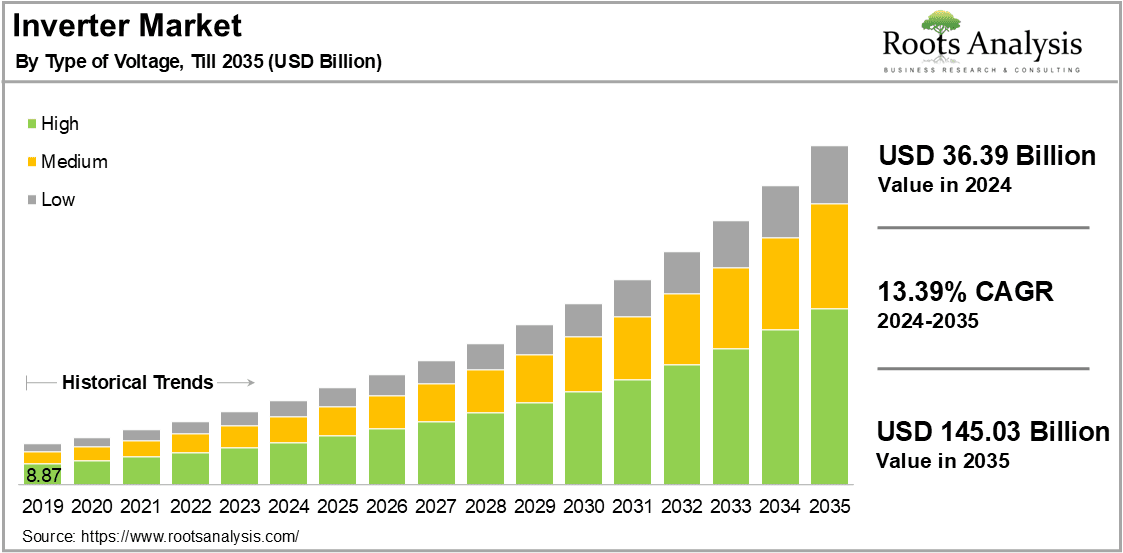
The inverter market size is projected to grow from $36.39 billion in 2024 to $145.03 billion by 2035, representing a CAGR of 13.39% during the forecast period 2024-2035.
 |
To learn more about this report, request a free sample copy
The new research study consists of industry trends, detailed market analysis, key market trends of the inverter market, SWOT analysis and value chain analysis.
The inverter market is powering the future with efficiency and innovation. The inverter market is emerging as a critical component in the global shift towards sustainable energy solutions. Inverters play a pivotal role in unlocking the full potential of renewable energy sources which makes them an increasingly essential aspect of modern energy infrastructure. Inverter is a type of electronic machine, which uses semiconductor and designed to convert direct current (DC) into alternating current (AC). Often, direct current is lower while AC is equal to the grid supply voltage which can be 120V or 240V. The market has a variety of inverters based on the shape of the switching waveform such as grid-tied inverters, off-grid inverters, hybrid-inverters, microinverters and others. These inverters have different circuit configurations, efficiency, and advantages. From residential homes to large-scale industrial facilities, the advantages of inverter technology are strengthening industries.
Additionally, one of the key benefits of inverters is their ability to provide a consistent and stable power supply, even in the face of fluctuations in the grid or renewable energy sources. This feature drives the popularity of inverters in residential and commercial spaces. With regard to this, to leverage this opportunity, stakeholders are providing a unique set of set of features and capabilities. Consequently, with continuous technological advancements, as the demand for energy and renewable energy continues to grow, the inverter market is anticipated to witness noteworthy growth during this forecast period.
Inverter Market Share Insights
The market report presents an in-depth analysis of the various service providers that are involved in offering inverter market, across different segments, as defined in the table below:
Inverter Market: Report Attributes / Market Segmentations
| Key Report Attributes | Details | |
| Historical Trend | 2019-2023 | |
| Base Year | 2023 | |
| Forecast Period | 2024-2035 | |
| Market Size Value in 2024 | $ 36.39 Billion | |
| Market Size Value by 2035 | $ 145.03 Billion | |
| Growth Rate | CAGR of 13.39% from 2024 to 2035 | |
| Type of Product |
|
|
| Type of Power Rating |
|
|
| Type of Voltage |
|
|
| Type of Connection |
|
|
| Type of Sales Channel |
|
|
| Type of End User |
|
|
| Geographical Regions |
|
|
| Leading Market Players |
|
|
| PowerPoint Presentation (Complimentary) |
Available | |
| Customization Scope | 15% Free Customization | |
| Excel Data Packs (Complimentary) |
|
|
Inverter Market Key Segments
Market Share by Type of Product
The global inverter market is segmented into various types of products, such as central inverters, hybrid inverters, microinverters, and string inverters. According to our analysis, central inverter segment will augment the segment's growth with the largest market share during this forecast period. The growing installation of solar photovoltaic systems in residential, commercial, and utility-scale projects is estimated to be a primary factor in boosting the segment growth. However, the string inverter segment is anticipated to grow at the fastest CAGR throughout this projection period owing to its cost-effectiveness, simplicity and reliability and wide applicability like rooftops, small commercial buildings and community solar projects.
Market Share by Type of Power Rating
Based on the type of power rating, the global inverter market is split into different types of power rating such as below10k W, 10kW-50kW, 50-100kW, and above 100kW. Among the categories, the 10kW -50kW segment is expected to gain the maximum market share and will dominate the segment till 2035. The versatility and wide range of applications make it the most popular option, thriving the segment growth. Moreover, above 100kW is projected to expand at a higher CAGR driven by the rising demand from utility-scale solar projects where high-power inverters are vital in generating huge amounts of electricity to be fed into the grid.
Market Share by Type of Voltage
The global inverter market is fragmented into multiple types of voltage ratings namely high, low, and medium. The high voltage segment is anticipated to dominate the segment with the highest market share over this forecast period. The expanding power generation with the distribution and transmission sector to meet the rising electricity demand, fosters segment growth. This has increased the size of photovoltaic plants in commercial, industrial and utility installations which will propel the thigh output voltage to invert market demand. While low-voltage inverts are predicted to experience a faster growth rate in the upcoming decade. The diverse use of low-voltage in residential to small medium-sized commercial solar installations is ascribed to support the growth of the low-voltage inverters market.
Market Share by Type of Connection
On the basis of the type of connection, the inverter market is bifurcated into grid-tied and stand-alone connections. As per our research, the grid-tied segment is projected to hold the majority of the market shares and will drive the segment growth until 2035. The high adoption of solar power systems in residential applications is grid-tied systems that fuel the segment demand, thereby aiding the market demand. In addition, the rise in rooftop installations and large-scale installations to ensure a consistent and reliable power supply are the factors attributed to uplifting the segment growth. Therefore, the grid-tied segment is expected to grow at a steady CAGR in the coming years.
Market Share by Type of Distribution Channel
Based on the types of distribution channels, the global inverter market is segmented into direct sales and indirect sales. According to our analysis, the direct sales channel leads the segment with the major market shares. Direct sales allow manufacturers to deliver customized inverter solutions that meet the specific requirements of large projects and their technical expertise offers direct technical support which is vital for complex installations and large-scale projects. Therefore, these factors are accredited to escalate the segment growth at a higher CAGR during this forecast period.
Market Share by Type of End User
This segment explains the distribution of the inverter market into several end users which include automotive, photovoltaic plants, residential, and others. The residential segment is estimated to acquire the maximum market share and will lead the segment throughout the forecast period. Factors, such as heightened demand for rooftop solar installations and government incentives like tax credits, and rebates to promote clean energy are the factors driving the demand for invert in residential sector. Whereas the automotive sector is predicted to experience a significant growth rate due to a rise in the adoption of electric vehicles where inverters play a pivotal role in converting direct current from the inverter into alternative current for the electric motor.
Market Share by Geographical Regions
This segment highlights the distribution of the Inverter Market across various geographical regions such as North America, Europe, Asia, Latin America, Middle East, North Africa, and the Rest of the World. According to our analysis, Asia exhibits dominance in the market with the majority of the inverter market share in the global marketplace. In terms of production and demand, Asia upsurges the leads the market owing to the growing number of consumers who are inclined towards electric vehicles, and solar energy. Furthermore, North America is projected to drive the market at a higher CAGR during this forecast period due to the higher adoption of clean energy solutions, strong government initiatives, tax incentives, and environmental concerns.
Inverter Market Key Insights
The “Inverter Market, Till-2035: Distribution Type of Product (Central Inverter, Hybrid Inverter, Micro Inverter, String Inverter) Type of Power Rating (Below10k W, 10-50kW, 50-100kW, and Above 100kW), Type of Voltage (High, Low, Medium), Type of Connection (Grid-Tied and Stand Alone), Type of Sales Channel (Direct and Indirect) Type of End-User (Automotive, Photovoltaic Plants, Residential, and Others), Geographical Regions (North America, Europe, Asia, Latin America and Middle East and North Africa and Rest of the World): Industry Trends and Global Forecasts “report features an extensive study of the current market landscape, market size and future opportunity within their inverter market, during the given forecast period. The market report highlights the efforts of several stakeholders involved in this rapidly emerging segment of the service providers industry. Key takeaways of the inverter market report are briefly discussed below.
Market Trends in Inverter Market
The expansion of the inverter industry with ongoing advancements in inverter technology, such as smart inverters and microinverters is one of the latest industry trends. Integration of innovative technologies that enable remote monitoring, diagnostics, and control, making it popular among end users. Apart from this, rising trend of integrating inverters with battery storage systems to offer reliable and uninterrupted power supply advances the market scope. In addition, utilization of large-scale storage systems in conjunction with inverters to stabilize the grid and manage renewable energy sources more effectively. As a consequence of this, by following market trends, in June 2024, Holymiles, (a Chinese inverter maker) introduced an efficient three-phase microinverter. The product features a wide MPPT voltage range which span around 12V to 136V.
Competitive Landscape of Inverter Market
The inverter market faces intense competition from several multinational companies and regional players. Established companies such as SMA, Huawei, Sungrow, and others are influencing the market growth with their innovative and broad product portfolio and strong R&D in solar inverters. It is interesting to note that the top five players capture the majority share of the market. Through strategic initiatives, like mergers and acquisitions, and a focus on changing customers’ needs, and strong efforts for geographical expansion, these companies strive to maintain their leading position in the global marketplace. For instance, in July 2024 Sungrow, (a global leader in PV inverter and energy storage systems) signed a deal with Hero Future Energies to supply 850 MW inverter. Through this deal Sungrow aims to expand its remarkable presence in India’s flouring clean energy space.
Key Drivers of Inverter Market
The increasing adoption of renewable energy sources is one of the notable factors in driving the inverter market growth. The rise in the use of solar and wind energy as sustainable power sources substantially contribute to uplifting the demand for inverters. Secondly, the surging demand for energy due to rapid urbanization and industrialization, specifically, in emerging economies, leads to heightened energy demand. Moreover, continuous technological advancements in smart inverter and energy storage integration are likely to fuel market development during this forecast period.
Regional Analysis: Asia is Expected to Dominate the Market with the Largest Inverter Market Share
With respect to regional insights, Asia is likely to dominate the market for inverters. Primarily, rapid urbanization and industrialization is one of the key market drivers. The fastest emerging economies in countries like China and India and their rising investment in renewable energy are accredited to foster the inverter market growth. Also, the expanding demand for energy due to the large and growing population in the region strengthens the inverter market development. Besides, China’s massive investment in solar and wind energy and the world’s largest production of solar panels and inverters are ascribed to the region’s market dominance. Additionally, large-scale renewable energy projects and their investment in clean energy will likely continue to retain the region’s position in the global market for inverters throughout this forecast 2024-2035.
Leading Companies in the Inverter Market
Examples of key service providers involved in the inverter market (which have also been captured in this market report, arranged in alphabetical order) include ABB (Switzerland), Delta (Taiwan), Enphase (USA), Fronius (Austria), General Electric (USA), Huawei (China), Power Electronics (Spain), Schneider (France), SMA (Germany), SolarEdge (Israel), Sungrow (China), and TMEIC (Japan). This market report includes an easily searchable Excel database of all the companies who have adopted the Inverter Market.
Inverter Market Report Coverage
The market report presents an in-depth analysis, highlighting the capabilities of various companies engaged in this domain, across different segments. Amongst other elements, the market report includes:
- A preface providing an introduction to the full report, inverter market, 2019-2023 (Historical Trends) and 2024-2035 (Forecasted Estimates).
- An outline of the systematic research methodology adopted to conduct the study on the inverter market, providing insights on the various assumptions, methodologies, and quality control measures employed to ensure the accuracy and reliability of our findings.
- An overview of economic factors that impact the overall inverter market, including historical trends, currency fluctuation, foreign exchange impact, recession, and inflation measurement.
- An executive summary of the insights captured during our research. It offers a high-level view on the current state of the market for inverter market and their likely evolution in the mid-long term.
- A detailed assessment of the inverter market landscape, based on several relevant parameters, including year of experience, company size, location of headquarters, and ownership structure.
- Elaborate profiles of prominent players engaged in the inverter market, featuring information on their year of establishment, location of headquarters, company size, company mission, company footprint, management team, contact details, financial information, operating business segments, inverter portfolio, moat analysis, recent developments, and an informed future outlook.
- A value chain analysis featuring a discussion on various stakeholders involved in the development of the inverter market, from suppliers to end-users.
- A discussion on affiliated trends, key drivers and challenges, under a SWOT framework, which are likely to impact the industry’s evolution, along with a Harvey ball analysis, highlighting the relative effect of each SWOT parameter on the overall inverter market.
- A detailed estimate of the current market size and the future growth potential of the inverter market over the next decade. Based on multiple parameters we have provided an informed estimate on the market evolution during the forecast period 2024-2035. The report also features the likely distribution of the current and forecasted opportunity within the inverter market. Further, in order to account for future uncertainties and to add robustness to our model, we have provided three forecast scenarios, namely conservative, base, and optimistic scenarios, representing different tracks of the industry’s growth.
- Detailed projections of the current and future inverter market across various types of product such as central inverter, hybrid inverter, micro-inverter, string inverter.
- Detailed projections of the current and future inverter market across various types of power rating such as below 10k W, 10-50kW, 50-100kW, and above 100kW.
- Detailed projections of the current and future inverter market across various types of voltage such as high, low, and medium.
- Detailed projections of the current and future inverter market across various types of connections such as grid-tied and stand alone.
- Detailed projections of the current and future inverter market across various types of sales channels such as direct and indirect.
- Detailed projections of the current and future inverter market across various types of end user such as automotive, photovoltaic plants, residential, and others.
- Detailed projections of the current and future market for interactive display across various geographical regions, such as North America (US, Canada, Mexico and other North American countries), Europe (Austria, Belgium, Denmark, France, Germany, Ireland, Italy, Netherlands, Norway, Russia, Spain, Sweden, Switzerland, UK and other European countries), Asia (China, India, Japan, Singapore, South Korea and other Asian countries), Middle East and North Africa (Egypt, Iran, Iraq, Israel, Kuwait, Saudi Arabia, UAE and other MENA countries), Latin America (Brazil, Chile, Colombia, Venezuela and other Latin American countries) and rest of the world (Australia, New Zealand and other countries).
Recent Developments in Inverter Market
- In July 2024, Deye launched SUN-20K-LV, the world’s first 20kw low-voltage three-phase hybrid inverter.
- In June 2024, SolarEdge (a leading company in smart energy technology) released its new solution for small-medium utility-scale and dual-use solar segment, SolarEdge Terra-Max Inverter combined with H1300 power optimizers in Germany.
- In June 2024, Fronius rolled out a residential string inverter for rooftop solar. This new Gen 24 single-phase inverter ranges from 3kW to 10kW.
- In May 2024, ABB introduced an innovative HES580 inverter, tailored for electric buses. The product allows greater lifespan and significant efficiency.
- In April 2024, Solplanet (a Chinese company) unveiled a new inverter solution for rooftop installation.
- In Jan 2024, Enphase Energy set in motion with the release of new IO8Mircoinverters for high-powered solar modules in North America.
Author(s): Ronit Sharma and Neha Kashyap
Customization Opportunities
At Roots Analysis, we genuinely care about your success and understand that your business requirements are unique. While our market research reports provide valuable insights, we recognize that they might not cover every aspect you need to make well-informed strategic decisions. To account for that, we offer 15% free report customization tailored to your specific needs. Whether you require additional quantitative analysis, qualitative insights, or any other information related to the inverter market, reach out us today at: support@rootsanalysis.com