Cybersecurity Certification Market
Cybersecurity Certification Market Till 2035: Distribution by Type of Certification Category (AI Certifications, Application Security Certifications, Cloud Security, and Information Security), Type of Target User (Enterprises and Individual Professionals), by Type of Delivery Mode (In-Person and Online), by Type of Offering (Certification Services, Platforms & Tools), by Company Size (Large Enterprises, Small and Medium Enterprises (SMEs)), and Key Geographical Regions (North America, Europe, Asia, Latin America, and Middle East and North Africa and Rest of the World) Industry Trends and Global Forecasts.
-
Lowest Price Guaranteed
-
Slides
194 -
Last Updated
October 2026 -
View Count
14268 -
Cybersecurity Certification Market Overview
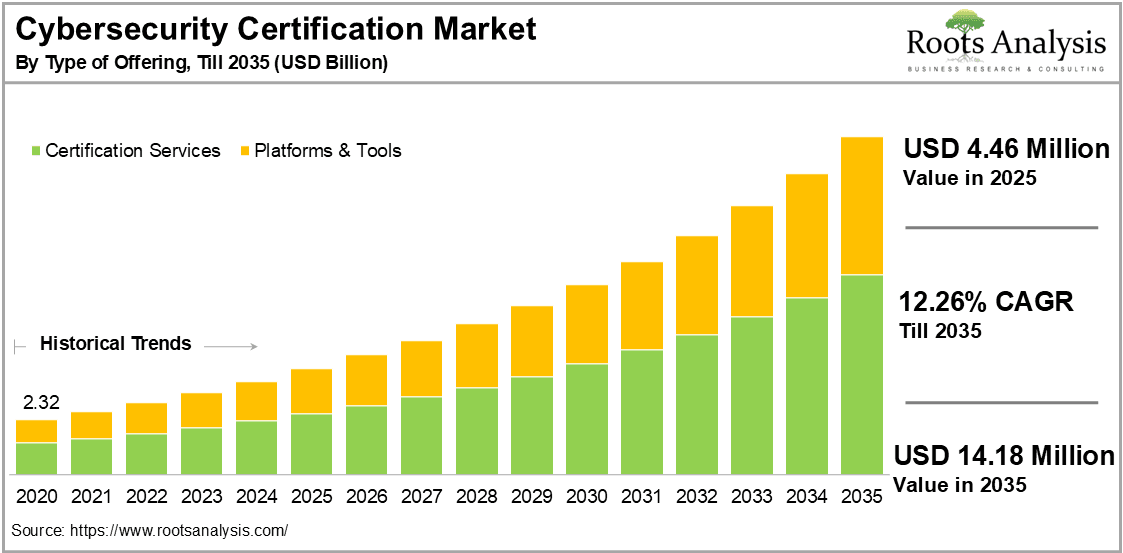
According to the global cybersecurity certification market size forecast, the market is projected to grow from USD 4.46 billion in 2025 to USD 14.18 billion by 2035, representing a CAGR of 12.26%, during the forecast period 2025-2035.
To learn more about this report, request a free sample copy
The new research study consists of detailed cybersecurity certification industry analysis, mega trends, patent analysis, porter five forces, SWOT analysis, value chain analysis and other strategic frameworks.
Cybersecurity certification is a formal process designed to validate the knowledge, skills, and competencies of professionals in the field of cybersecurity. It involves rigorous training, coursework, and examinations that assess an individual's proficiency in critical areas, such as network security, ethical hacking, risk management, and incident response. These certifications serve as a benchmark for both individuals and organizations, ensuring that certified professionals possess the necessary expertise to protect digital infrastructures against an ever-evolving landscape of cyber threats.
The cybersecurity certification market has become essential due to the increasing frequency and complexity of cyber threats. This market encompasses certifications that validate the skills and expertise of professionals in safeguarding digital infrastructure, crucial for both individual competency and organizational trust. With the proliferation of digitalization and stricter compliance regulations, demand for certified cybersecurity professionals continues to surge. This demand is further driven by demand for cybersecurity certifications in finance and healthcare, government, and IT. Key end-users include government institutions and private corporations seeking fortified defense mechanisms against cyber threats.
Cybersecurity Certification Market Share Insights
The market report presents an in-depth analysis of the various companies that are involved in offering cybersecurity certification solutions, across different segments, as defined in the table below:
Cybersecurity Certification Market: Report Attributes / Market Segmentations
| Key Report Attributes | Details | |
| Historical Trend | Since 2020 | |
| Forecast Period | 2025-2035 | |
| Market Size Value in 2025 | $ 4.46 Billion | |
| Market Size Value by 2035 | $ 14.18 Billion | |
| CAGR (Till 2035) | 12.26% | |
| Type of Certification Category |
|
|
| Type of Target Users |
|
|
| Type of Delivery Mode |
|
|
| Type of Offering |
|
|
| Company Size |
|
|
| Geographical Regions |
|
|
| Leading Market Players |
|
|
| PowerPoint Presentation (Complimentary) |
Available | |
| Customization Scope | 15% Free Customization | |
| Excel Data Packs (Complimentary) |
|
|
Cybersecurity Certification Market Segmentation
Market Share by Type of Certification Category
Based on the types of certification categories, the global cybersecurity certification market is split into AI certifications, application security certifications, cloud security, information security. According to the cybersecurity certification market outlook, the information security segment growth is expected to be the maximum, capturing a market share of 58.34% by 2035. This can be attributed to the urgent need for organizations to protect sensitive data and comply with regulatory requirements.
On the other hand, it is worth highlighting that the cloud security segment is expected to witness the fastest CAGR of around 13.67% during the forecasted period. This growth is the result of organizations continuing to migrate their operations to cloud environments, further necessitating specialized skills to manage associated risks.
Market Share by Type of Target Users
Based on the types of target users, the global cybersecurity certification market is split into enterprises and individual professionals. Among these categories, the enterprises segment share is expected to be the maximum, capturing a market share of 76.34% by 2035. This can be attributed to the increasing need for organizations to comply with regulatory standards and enhance their security postures against cyber threats Enterprises are investing heavily in cybersecurity certifications to ensure that their workforce is equipped with the necessary skills to protect sensitive data and comply with frameworks such as GDPR and HIPAA.
On the other hand, the individual professionals segment is expected to witness the fastest CAGR of around 14.8% during the forecasted period. This segment growth can be attributed to the growing emphasis on personal career development and the increasing demand for certified professionals in a job market facing a significant skills gap.
Market Share by Type of Delivery Mode
The global cybersecurity certification market is segmented into various types of delivery modes, such as in-person and online. According to our cybersecurity certification market forecast, the online segment will augment the segment's growth with the largest market share of over 78.56% as well as the fastest CAGR of around 15.87% by the next decade. The market growth can be attributed to its adaptability, accessibility, and cost-effectiveness, allowing professionals to engage in training without geographical constraints. The COVID-19 pandemic has further accelerated the shift towards virtual education, making online certifications the preferred choice for many seeking to enhance their cybersecurity skills.
Market Share by Type of Offering
The global cybersecurity certification market is segmented into various types of offerings, such as certification services and platforms & tools. According to our global cybersecurity certification market analysis, the certification services segment will augment the segment's growth with the largest market share of over 88.56% by the next decade. The market growth can be attributed to the increasing demand or formal validation of skills and knowledge in the face of escalating cyber threats and regulatory requirements. On the other hand, it is worth highlighting that the platforms & tools segment is expected to witness the fastest CAGR of around 16.7%. This growth can be attributed to the rising need for innovative solutions that facilitate continuous learning and skill development in cybersecurity.
Market Share by Company Size
The global cybersecurity certification market is fragmented into multiple types of enterprise namely large and small and medium enterprise. Currently, the large enterprise segment is anticipated to dominate the segment with 73.87% of the cybersecurity certification market share. However, small and medium enterprise segments are expected to witness a relatively higher (16.28%) global cybersecurity certification market growth rate until 2035. This is ascribable to their agility, innovation, focus on niche markets, and ability to adapt to changing customer preferences and market conditions.
Market Share by Geographical Regions
This segment highlights the distribution of market share of cybersecurity certification solutions by region, such as North America, Europe, Asia, Latin America, Middle East and North Africa, and the rest of the world. According to our regional analysis of cybersecurity certification markets, North America currently exhibits dominance with 37.69% of the overall market share. This growth is owed to the high concentration of leading cybersecurity firms, stringent regulatory requirements, and a significant number of cyber threats. Organizations in this region are heavily investing in cybersecurity certifications to comply with regulations such as GDPR and HIPPA, further enhancing their security posture and credibility.
Cybersecurity Certification Market Key Insights
The “Cybersecurity Certification Market, Till-2035: Industry Trends and Global Forecasts” report features an extensive study of the current market landscape, market size and future opportunity within the cybersecurity certification market, during the given forecast period. The market report highlights the efforts of several stakeholders involved in this rapidly emerging segment of the service providers industry. Key takeaways of the cybersecurity certification market report are briefly discussed below.
Cybersecurity Certification Market Drivers
According to cybersecurity certification industry trends, the market is expected to be driven by rising cyber-attacks and data breaches as well as the global shortage of cybersecurity experts. Rising cyber-attacks and data breaches are major contributors to this demand, as organizations recognize the necessity of having skilled personnel to mitigate risks and protect sensitive information. Additionally, regulatory compliance certifications (GDPR, HIPAA) plays a crucial role and various industry-specific standards compel organizations to pursue certifications to demonstrate adherence to security protocols and build trust with customers and stakeholders.
The global shortage of cybersecurity experts, estimated at over 3.5 million, further amplifies the need for certifications that validate skills and competencies in a rapidly evolving threat landscape. Moreover, the integration of emerging technologies like artificial intelligence (AI) and the Internet of Things (IoT) introduces new vulnerabilities, necessitating specialized certifications to equip professionals with the expertise required to address these challenges effectively. As organizations increasingly prioritize cybersecurity in their operational strategies, the demand for certification services continues to surge, positioning the market for significant growth in the coming years.
Competitive Landscape of Cybersecurity Certification Market
With the presence of several small and large cybersecurity certification companies, the competitive landscape of the cybersecurity certification market is experiencing intense competition and changing cybersecurity certification market dynamics. From large multinational companies to local cybersecurity certification players, companies are striving to enhance their competitive edge. In terms of market share, large enterprises and multinational companies are dominating the market. With the help of advancements in cybersecurity certification programs, small cybersecurity certification market players are continuously improving their products to cater to niche markets, or they are offering specialized cybersecurity certification solutions.
These industry players are focusing on adopting competitive strategies, such as developing innovative cybersecurity certification solution techniques, forming strategic alliances and partnerships to expand their portfolios and global footprint, investing in recent developments and new feature launches to enhance their products offerings. For instance, in June 2024, new IBM SkillsBuild Cybersecurity and data analytics certificates were deployed in community college systems across Alabama, California Bay Area, Colorado and Louisiana. In reference to this, Dr. Courtney Monette, Special Programs Project Director, Alabama Community College System, stated that Alabama community college is working with IBM to pilot the Cybersecurity Certificate because of the strong need for entry-level competency-based credentials that help students start on a pathway for an IT career.
Cybersecurity Certification Market Challenges
Despite the strong market growth projection, there are several challenges in cybersecurity certification deployment. One significant issue is the high cost and time commitment associated with obtaining and maintaining certifications, which can deter potential candidates from pursuing these qualifications. Additionally, the rapidly evolving nature of cyber threats means that certification programs must continually update their content to remain relevant; however, this can create a lag between the latest industry practices and the certification curriculum, leading to a gap in knowledge. Moreover, the presence of numerous certification bodies has resulted in a lack of uniform standards, which can confuse employers and professionals alike regarding the value of different certifications.
Regional Analysis: North America is Expected to Dominate the Market with the Largest Cybersecurity Certification Market Share
With respect to regional cybersecurity certification industry insights, North America is likely to dominate the market for the forecasted period. The dominance of this region is majorly due to the presence of a highly developed and technologically advanced economy with widespread digital adoption across various applications of cybersecurity certifications, including finance, healthcare, and technology. Moreover, stringent regulatory requirements, such as GDPR and HIPAA, compel organizations to prioritize cybersecurity certifications to demonstrate compliance and build trust with customers and partners, further propelling the market growth.
Leading Cybersecurity Certification Companies
Examples of major players in the global cybersecurity certification industry (which have also been captured in this market report, arranged in alphabetical order) include A-Lign, Akamai, Amazon Web Services, Bureau Veritas, Check Point Software Technologies, Cisco Systems, Coalfire Certification, CrowdStrike Holdings, DEKRA, DNV GL, DQS, Elements Materials Technology, Eurofins Scientific, EY Certifypoint, Exida, F5, Fortinet, IBM, Infosec Train, ISC2, Isaca, Isasecure, Juniper Networks, Kaspersky, Keysight, McAfee, Microsoft, OffSec Services, Palo Alto Networks, Proofpoint, Qualys, Rapid7, Schellman, Sophos, Tenable, TUV Nord, TUV Rheinland, TUV SUD, Trend Micro, UL Solutions, VMware.
Recent Developments in Cybersecurity Certification Market
- In December 2024, CompTIA launched expert-level cybersecurity certification, CompTIA SecurityX, a certification aimed at security architects and senior security engineers working toward enterprise cybersecurity readiness.
- In August 2024, ICRI, and EC-Council partnered to launch a certification program in ethical hacking and cybersecurity.
- In June 2024, CERT-In and Mastercard India signed a MoU for collaboration in cyber security to enhance India’s cyber-resilience in financial sector.
Cybersecurity Certification Market Report Coverage
The market report presents an in-depth analysis, highlighting the capabilities of various companies engaged in this domain, across different segments. Amongst other elements, the market report includes:
- A preface providing an introduction to the full report, cybersecurity certification market, 2020-2025 (Historical Trends) and till-2035 (Forecasted Estimates).
- An outline of the systematic research methodology adopted to conduct the study on the cybersecurity certification market, providing insights on the various assumptions, methodologies, and quality control measures employed to ensure the accuracy and reliability of our findings.
- An overview of economic factors that impact the overall cybersecurity certification market, including historical trends, currency fluctuation, foreign exchange impact, recession, and inflation measurement.
- An executive summary of the insights captured during our research. It offers a high-level view of the current state of the cybersecurity certification market and its likely evolution in the mid-long term.
- A detailed assessment of the cybersecurity certification market landscape, based on several relevant parameters, including year of experience, company size, location of headquarters, and ownership structure.
- Elaborate profiles of prominent players engaged in the cybersecurity certification market, featuring information on their year of establishment, location of headquarters, company size, company mission, company footprint, management team, contact details, financial information, operating business segments, cybersecurity certification portfolio, moat analysis, recent developments, and an informed future outlook.
- A qualitative assessment of the various megatrends ongoing in the integration with emerging technologies and threats, skill gaps in cybersecurity, and industry-specific certifications.
- An analysis highlighting the key unmet needs across cybersecurity certification industry, featuring cybersecurity certification market research insights generated from real-time data on unmet needs as identified from social media posts, recent publications, industry blogs and the views of key opinion leaders expressed on online platforms.
- An in-depth analysis of various patents that have been filed / granted related to cybersecurity certification and its components, based on various parameters, such as type of patent, patent publication year, patent age and leading players
- A detailed analysis of recent developments in the cybersecurity certification domain, based on relevant parameters such as year of initiative, type of initiative (partnerships and collaborations, expansions, funding and product launches), geographical distribution and most active players (in terms of number of recent developments).
- Key winning strategies framework that helps in analyzing the level of competition within an industry, by tracing the key market activities including partnership, funding, expansion of leading players.
- A qualitative analysis, highlighting the five competitive forces prevalent in cybersecurity certification industry, including threats for new entrants, bargaining power of suppliers, bargaining power of customers, threats of substitution and rivalry among existing competitors.
- A discussion on affiliated global cybersecurity certification market trends, key drivers and challenges, under a SWOT framework, which are likely to impact the industry’s evolution, along with a Harvey ball analysis, highlighting the relative effect of each SWOT parameter on the overall cybersecurity certification market.
- A value chain analysis featuring a discussion on various stakeholders involved in the development of the cybersecurity certification market, from suppliers to end-users.
- A detailed estimate of the current market size and the future growth potential of the cybersecurity certification market over the next decade. Based on multiple parameters we have provided an informed estimate on the market evolution during the forecast period 2025-2035. The report also features the likely distribution of the current and forecasted opportunity within the cybersecurity certification market. Further, in order to account for future uncertainties and to add robustness to our model, we have provided three forecast scenarios, namely conservative, base, and optimistic scenarios, representing different tracks of the industry’s growth.
- Detailed projections of the current and future market across various types of certification category such as AI certifications, application security certifications, cloud security, information security.
- Detailed projections of the current and future market across various types of target users such as enterprises and individual professionals.
- Detailed projections of the current and future market across various types of delivery mode such as in-person and online.
- Detailed projections of the current and future market across various types of offering such as certification services and platforms & tools.
- Detailed projections of the current and future cybersecurity certification market across various geographical regions, such as North America (US, Canada, Mexico and other North American countries), Europe (Austria, Belgium, Denmark, France, Germany, Ireland, Italy, Netherlands, Norway, Russia, Spain, Sweden, Switzerland, UK and other European countries), Asia (China, India, Japan, Singapore, South Korea and other Asian countries), Middle East and North Africa (Egypt, Iran, Iraq, Israel, Kuwait, Saudi Arabia, UAE and other MENA countries), Latin America (Brazil, Chile, Colombia, Venezuela and other Latin American countries) and rest of the world (Australia, New Zealand and other countries).
Author: Ronit Sharma and Anmol Bali
Customization Opportunities
At Roots Analysis, we genuinely care about your success and understand that your business requirements are unique. While our cybersecurity certification research reports provide valuable insights, we recognize that they might not cover every aspect you need to make well-informed strategic decisions. To account for that, we offer 15% free report customization tailored to your specific needs. Whether you require additional quantitative analysis, qualitative insights, or any other information related to the cybersecurity certification market, reach out us today at:support@rootsanalysis.com