Acetic Acid Market
Acetic Acid Market, Till 2035: Distribution by Type of Application (Acetate Esters, Acetic Anhydride, Butyl Acetate, Ethyl Acetate, Purified Terephthalic Acid, Vinyl Acetate Monomer, and Others), Type of End User (Chemicals, Food and Beverage, Paints & Coatings, Pharmaceuticals, Plastics and Polymers, and Textiles), and Type of Geographical Regions (North America, Europe, Asia, Latin America, and Middle East and North Africa and Rest of the World): Industry Trends and Global Forecasts
-
Lowest Price Guaranteed
-
Slides
207 -
Last Updated
August 2026 -
View Count
13691 -
Acetic Acid Market Overview
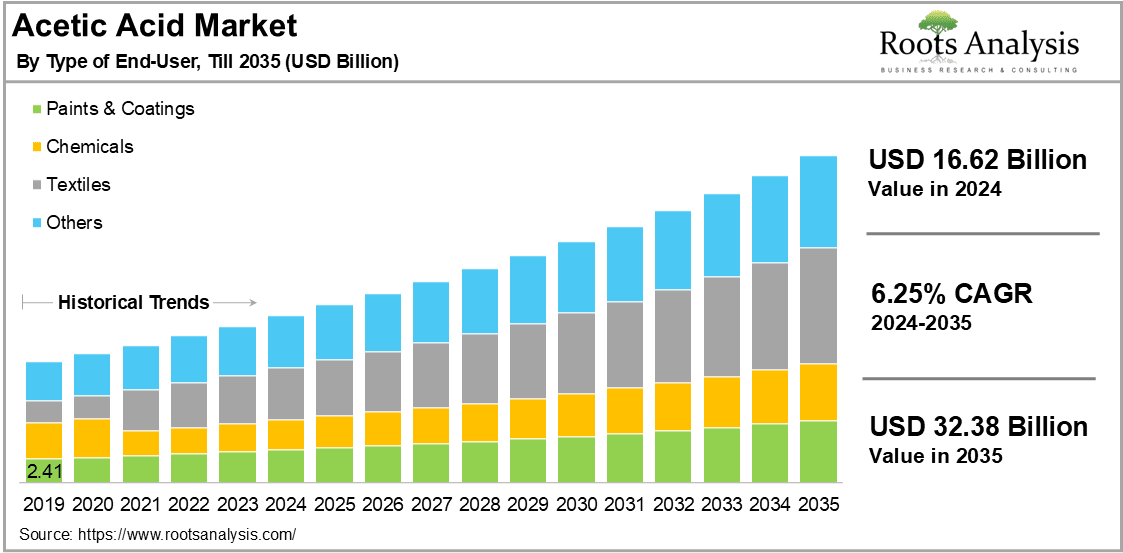
The acetic acid market size is projected to grow from $16.62 billion in 2024 to $32.38 billion by 2035, representing a CAGR of 6.25% during the forecast period 2024-2035.
|
|
To learn more about this report, request a free sample copy
The new research study consists of industry trends, detailed market analysis, key market trends of the acetic acid market, SWOT analysis and value chain analysis.
Acetic acid is an organic compound produced by fermentation and oxidation of natural carbohydrates which is called vinegar. With the chemical formula CH3COOH, acetic acid is commonly referred to as ethanoic acid, ethylic acid, and methane carboxylic acid. It appears as a colorless liquid with strong odor of vinegar. Acetic acid has many uses and benefits for various industrial as well as household purposes. Generally, consumers are aware of acetic acid in terms of the form of household vinegar and widely used in food preparation. Whereas, industrially, acetic acid is significantly applied in the making of several chemicals including vinyl acetate monomer which is highly used in the printing process while cellulose acetate is employed in the production of plastics and fibers. In terms of higher demand, textiles and chemical industry are some of the prominent end users, fueling the growth of the acetic acid market.
After acknowledging the importance of acetic acid in industrial applications, market players are increasingly investing in the market. As an example, in April 2024 Celanese extended global vinyl acetate ethylene (VAE) footing with a new plant in China. This new plant can produce an additional 70,000 metric tons of vinyl acetate ethylene, adding to the company's ability for years against record high supply in Asia. However, the synthetic production of acetic acid has some environmental impacts mainly when it is synthesized through the methanol carbonylation process. This process causes greenhouse gas emissions which is one of the most environmental concerns associated with acetic acid production. Therefore, several companies are inclining towards biomass technology to meet sustainability goals, leveraging the opportunity by producing eco-friendly acetic acid. Overall, the acetic acid market is anticipated to experience an excellent growth rate over this forecast period driven by the growing applications of acetic acid and rising demand from pharmaceuticals, plastics and polymers, and the rising government initiatives for sustainable acetic acid production.
Acetic Acid Market Share Insights
The market report presents an in-depth analysis of the various service providers that are involved in offering acetic acid market, across different segments, as defined in the table below:
Acetic Acid Market: Report Attributes / Market Segmentations
| Key Report Attribute | Details | |
| Historical Trend | 2019-2023 | |
| Base Year | 2023 | |
| Forecast Period | 2024-2035 | |
| Market Size Value in 2024 | $ 16.62 Billion | |
| Market Size Value by 2035 | $ 32.38 Billion | |
| Growth Rate | CAGR of 6.25% from 2024 to 2035 | |
| Type of Application |
|
|
| Type of End User |
|
|
| Geographical Regions |
|
|
| Leading Market Players |
|
|
| PowerPoint Presentation (Complimentary) |
Available | |
| Customization Scope | 15% Free Customization | |
| Excel Data Packs (Complimentary) |
|
|
Acetic Acid Market Key Segments
Market Share by Type of Application
The distribution of the global acetic acid market is bifurcated into different types of applications such as acetate esters, acetic anhydride, butyl acetate, ethyl acetate, purified terephthalic acid, vinyl acetate monomer, and others. According to our projection, vinyl acetate is likely to dominate the segment with the majority of the market share. This trend is expected to continue till 2035 majorly due to the greater use of acetic acid in adhesive and sealants. VAM or vinyl acetate is a key component for producing resins and adhesives which is commonly used in construction, automotive, paints, and packaging sectors. Therefore, with the heightening demand from these end-use industries will likely continue to fuel the consumption of vinyl acetate. However, the purified terephthalic acid segment is projected to foster market growth with the highest CAGR in the upcoming decade. The key factor behind the growth of the segment can be ascribed to the rising demand for polyethylene terephthalate bottles, plastics, polyester films, and fiber as acetic acid is applied as a processing agent in the production of such end products, thereby inflating demand for the acid.
Market Share by Type of End User
Based on the types of end users, the global acetic acid market is fragmented into chemicals, food and beverage, paints & coatings, pharmaceuticals, plastics and polymers, and textiles. As per market research, the chemical and paints & coating end use industries are anticipated to elevate the segment growth and will lead the market with a major market share. Acetic acid is an essential raw material for creating several chemical derivatives such as vinyl acetate monomer, purified terephthalic, and acetic anhydride. These are the major derivatives that are widely utilized in diverse industries. Hence, the hike in demand for acetic acid for production of these derivatives is attributed to driving the acetic acid market growth. Moreover, the textile industry is estimated to expand at a higher CAGR during this forecast period. The significance of acetic acid in dyeing and finishing processing where it aids in controlling the pH baths and is crucial in achieving the desired color and quality in fabric, accelerating the growth of the acetic acid market.
Market Share by Geographical Regions
This segment highlights the distribution of the acetic acid market across various geographical regions such as North America, Europe, Asia, Latin America, the Middle East, North Africa, and the rest of the world. According to our analysis, Asia is the dominating region that holds the maximum acetic acid market share. The expansion of construction, textiles manufacturing, and large-scale production of acetic acid in the region are some of the major factors that contribute to the elevating acetic acid market growth in Asia. Moreover, North America is projected to grow with a steady growth rate due to its robust chemical industry, established pharmaceutical sector and continuous technological advancement in the field of acetic acid production.
Acetic Acid Market Key Insights
The “Acetic Acid Market, Till-2035: Distribution by Type of Application (Acetate Esters, Acetic Anhydride, Butyl Acetate, Ethyl Acetate, Purified Terephthalic Acid, Vinyl Acetate Monomer, and Others), Type of End User (Chemicals, Food and Beverage, Paints & Coatings, Pharmaceuticals, Plastics and Polymers, and Textiles), and Geographical Regions (North America, Europe, Asia, Latin America and Middle East and North Africa and Rest of the World): Industry Trends and Global Forecasts” report features an extensive study of the current market landscape, market size and future opportunity within their acetic acid Market, during the given forecast period. The market report highlights the efforts of several stakeholders involved in this rapidly emerging segment of the service providers industry. Key takeaways of the acetic acid market report are briefly discussed below.
Market Trends in Acetic Acid Market
The market for acetic acid is projected to thrive driven by several factors along with emerging market trends. The shift towards bio-based acetic acid is one of the latest industry trends, notably boosting the market demand. Driven by the growing emphasis on sustainable practices in the production of chemicals that play a substantial role in the carbon footprint of any product, companies are adopting green principles chemistry. Thus, industry players are employing biomass technology to manufacture acetic acid that reduces the global warming potential and offers renewable and eco-friendly alternatives. By following the trend, leading chemical producing companies and emerging startups are partnering to develop novel technologies such as metabolic engineering and genetically modified microorganisms for the production of new bio-based acids. As a result, the bio-based acetic acid market size is expected to rise in the future driven by these factors.
Competitive Landscape of Acetic Acid Market
The competitive landscape of the acetic acid market is marked by the presence of established corporations and small & medium regional companies. Interestingly, established market players lead the market with their largest profit revenue. Their innovative product portfolio, high investment in the development of cost-effective technology for the production of acetic acid, strategic partnership, collaboration, and acquisition along with sustainable practices support them in dominating the market. While, medium and small key players adopt innovative technologies, and processes, focus on specialization in niche markets and offer unique products combined with supply chain integration with larger companies which help them to stay ahead of the competition.
Key Drivers of Acetic Acid Market
Predominantly, the growth of the textile industry along with increasing demand from the pharmaceutical sector are the major key drivers in accelerating the acetic acid market growth. Acetic acid is a key component that is largely used in the development of drugs. While, in textiles processing, it is extensively used in dyeing and fabric finishing. Furthermore, the surge in demand for vinyl acetate monomer is another important driving factor to expand the market scope as it is utilized as a base material in the production of resins and polymers for adhesives, coatings films, paints and other end products. Besides, the advancements in production technology similar to low-carbon processes and advanced catalysts are making acetic acid production more efficient and cost-effective. Consequently, these factors are likely to support the market to reach its potential growth rate during this forecast period.
Regional Analysis: Asia is Anticipated to Lead the Market with the Largest Acetic Acid Market Share
With regard to geographical insights, China is one of the prominent nations that drive the acetic acid market development in Asia due to its huge coal derived methanol production which is the primary raw material for acetic acid. Also, China is a major producer and exporter of plastics specifically, polyethylene terephthalate, which is made of purified terephthalic acid, thereby boosting the growth of the acetic acid market in the region. Additionally, rapid industrialization and urbanization are also a considerable factor to boost the demand for chemicals, like acetic acid which is used in many applications including textiles, plastics, and pharmaceuticals. The expansion of the construction and packaging sectors coupled with the higher availability of raw materials of acetic acid are some other factors contributing to the region’s leading position in the global acetic acid market.
Leading Companies in the Acetic Acid Market
Examples of key service providers involved in the acetic acid market (which have also been captured in this market report, arranged in alphabetical order) include Airedale (UK), BASF (Germany), BP Plc (UK), British Petroleum (UK), Celanese (US), Daicel (Japan), DubiChem (UAE), Eastman Chemical (USA), Gujarat Narmada Valley Fertilizers & Chemicals (India), HELM (Germany), INEOS (UK), Jiangsu Sopo (China), Jubilant Life Sciences (India), KH Chemicals (Netherlands), LyondellBasell (USA), Mitsubishi (Japan), PetroChina (China), SABIC (Saudi Arabia), Sinopec (China), Shanghai Huayi (China), Shandong Hualu-Hengsheng (China), Spectrum Chemical (US), Wacker Chemie (Germany). This market report includes an easily searchable Excel database of all the companies who have adopted the acetic acid market.
Acetic Acid Market Report Coverage
The market report presents an in-depth analysis, highlighting the capabilities of various companies engaged in this domain, across different segments. Amongst other elements, the market report includes:
- A preface providing an introduction to the full report, acetic acid market, 2019-2023 (Historical Trends) and 2024-2035 (Forecasted Estimates).
- An outline of the systematic research methodology adopted to conduct the study on acetic acid market, providing insights on the various assumptions, methodologies, and quality control measures employed to ensure the accuracy and reliability of our findings.
- An overview of economic factors that impact the overall acetic acid market, including historical trends, currency fluctuation, foreign exchange impact, recession, and inflation measurement.
- An executive summary of the insights captured during our research. It offers a high-level view on the current state of the market for acetic acid market and their likely evolution in the mid-long term.
- A detailed assessment of the acetic acid market landscape, based on several relevant parameters, including year of experience, company size, location of headquarters, and ownership structure.
- Elaborate profiles of prominent players engaged in the acetic acid market, featuring information on their year of establishment, location of headquarters, company size, company mission, company footprint, management team, contact details, financial information, operating business segments, acetic acid portfolio, moat analysis, recent developments, and an informed future outlook.
- A value chain analysis featuring a discussion on various stakeholders involved in the development of the acetic acid market, from suppliers to end-users.
- A discussion on affiliated trends, key drivers and challenges, under a SWOT framework, which is likely to impact the industry’s evolution, along with a Harvey ball analysis, highlighting the relative effect of each SWOT parameter on the overall acetic acid market.
- A detailed estimate of the current market size and the future growth potential of the acetic acid market over the next decade. Based on multiple parameters we have provided an informed estimate on the market evolution during the forecast period 2024-2035. The report also features the likely distribution of the current and forecasted opportunity within acetic acid market. Further, in order to account for future uncertainties and to add robustness to our model, we have provided three forecast scenarios, namely conservative, base, and optimistic scenarios, representing different tracks of the industry’s growth.
- Detailed projections of the current and future acetic acid market across various types of application such as acetate esters, acetic anhydride, butyl acetate, ethyl acetate, purified terephthalic acid, vinyl acetate monomer, and others.
- Detailed projections of the current and future acetic acid market across various types of end user such as chemicals, food and beverage, paints & coatings, pharmaceuticals, plastics and polymers, and textiles.
- Detailed projections of the current and future market for acetic acid across various geographical regions, such as North America (US, Canada, Mexico, and other North American countries), Europe (Austria, Belgium, Denmark, France, Germany, Ireland, Italy, Netherlands, Norway, Russia, Spain, Sweden, Switzerland, UK and other European countries), Asia (China, India, Japan, Singapore, South Korea and other Asian countries), Middle East and North Africa (Egypt, Iran, Iraq, Israel, Kuwait, Saudi Arabia, UAE and other MENA countries), Latin America (Brazil, Chile, Colombia, Venezuela and other Latin American countries) and rest of the world (Australia, New Zealand and other countries).
Recent Developments in Acetic Acid Market
- In July 2024, BASF received ISCC+ certification for acetates, acrylics, alcohols and glycol ethers across all its global largest production sites.
- In April 2024, Celanese initiated a construction of a new 1.3-million-ton acetic acid expansion in Clear Lake, Texas. The company claimed that this expansion would be the world’s most affordable and environmentally friendly acetic acid plant.
- In January 2024, Again (a climate tech startup) entered into a partnership with HELM for the distribution and sales of its acetic acid products.
Author(s): Ronit Sharma and Neha Kashyap
Customization Opportunities
At Roots Analysis, we genuinely care about your success and understand that your business requirements are unique. While our market research reports provide valuable insights, we recognize that they might not cover every aspect you need to make well-informed strategic decisions. To account for that, we offer 15% free report customization tailored to your specific needs. Whether you require additional quantitative analysis, qualitative insights, or any other information related to the acetic acid market, reach out us today at: support@rootsanalysis.com